
How Fitness Fortunes Are Built on Fury
Susan Powter screamed “Stop the Insanity!” and sold $50 million a year. Billy Blanks turned punching air into $80 million in first-year VHS sales. Jillian Michaels berated people on national television and built an $18 million empire. The fitness industry’s most bankable emotion isn’t inspiration, it’s The Anger Economy.
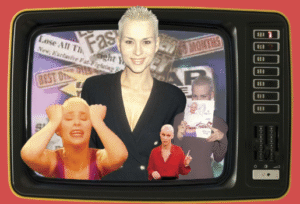
Here’s something nobody in the wellness industry wants to say out loud: the trainers who smile at you plateau. The trainers who give you permission to be furious scale. Inspiration is a sugar high. It spikes, crashes, and needs constant replenishment. Anger is a slow-burning fuel. It lasts as long as the enemy exists. And in the fitness industry, the enemy always exists.
The diet industry that took your money. The medical establishment that gave you a pill instead of a plan. The ex-husband who made you feel small. The culture that told you your body was wrong. These enemies don’t disappear. They regenerate. Which is why empires built on fury have longer half-lives than empires built on good vibes.
The Primal Scream: Susan Powter and the Architecture of Rage
Susan Powter didn’t become a fitness phenomenon because she had better exercise tips. She became a phenomenon because she was angrier than her audience and gave them permission to feel the same way.
The backstory is the blueprint. In 1986, Powter’s husband left her. She turned to food, going from 130 to 260 pounds. She then turned to the diet and fitness industry for help and discovered what millions of women already knew: it was designed to fail them. The calorie counting was unsustainable. The workout tapes assumed you were already fit. The entire apparatus was built to extract money, not deliver results.
Most people who reach this conclusion feel defeated. Powter felt enraged. That distinction made her a fortune.

“Stop the Insanity!” wasn’t a fitness slogan. It was a primal scream wearing a leotard. The press called her “one part Richard Simmons and one part Betty Friedan.” She was described as “the Lenny Bruce of Wellness.” These comparisons weren’t about her exercise routines. They were about her emotional register. Powter’s audiences didn’t show up for the low-fat recipes. They showed up because a barefoot woman with a platinum buzzcut was saying what they felt but couldn’t articulate: the whole system is rigged, and you have every right to be furious about it.
The Economics of the Scream
The numbers tell the story. In 1993 alone, Powter’s corporation earned an estimated $50 million. At its peak, her infomercials moved 15,000 kits per week at $79.80 each. Her first book became a national bestseller in its opening week. She got a $2 million advance for the paperback follow-up. A talk show. QVC appearances. Appearances on Leno and Letterman. Nearly 200 television stations carried her syndicated show.
All of this powered by one emotion: fury at an industry that profited from women’s insecurity.
The important thing to understand about Powter’s business model is that the anger wasn’t marketing. The anger was the product. Women weren’t buying fitness tips they could get from any VHS tape at Blockbuster. They were buying validation. Permission to be enraged at the diet industry, at beauty standards, at the systems that had failed them. The $79.80 kit was a ticket to the rage rally.
A 2025 documentary, “Stop the Insanity: Finding Susan Powter,” executive produced by Jamie Lee Curtis, reveals where that rage eventually led. Powter now drives for Uber Eats in Las Vegas. She delivers the fast food she once excoriated. Her current estimated net worth: $50,000. But even in the documentary’s Q&A, her emotional fuel hadn’t changed. “I didn’t heal. I’m not full of love and joy,” she told the festival audience. “I’m enraged and full of love and joy.”
The rage persists. The business didn’t. We’ll come back to why.
Aggression with Plausible Deniability: Billy Blanks and the Violence of Cardio
Billy Blanks understood something that every step aerobics instructor missed: punching air feels better than stepping on a plastic platform.

Tae Bo wasn’t aerobics with kicks. It was combat with a heart rate monitor. The name itself encoded the aggression: “Tae” from taekwondo, “Bo” from boxing. Two fighting disciplines repackaged as a fitness class. Blanks gave millions of people who would never throw a real punch the experience of throwing hundreds of them per session.
The results were staggering. In its first year, Tae Bo sold over 1.5 million VHS tapes, generating $80 million in sales. Lifetime revenue exceeded $150 million. Blanks’ current estimated net worth sits at $20 million, built almost entirely on the insight that people want to hit something when they work out.
The Psychology of the Punch
What made Tae Bo different from every other home fitness program wasn’t the calorie burn or the martial arts technique. It was the emotional release mechanism built into every workout.
When you do a Tae Bo session, you’re not just exercising. You’re expressing something. The jab isn’t aimed at a heavy bag. It’s aimed at your boss, your commute, your credit card statement, your body in the mirror. Blanks never said this explicitly. He didn’t have to. The physical vocabulary of combat communicated what no motivational speech could: you have rage inside you, and this is a safe container for it.
Blanks’ own origin story amplified this. Born with a hip joint anomaly, one of fifteen children, dyslexic, clumsy, mocked by siblings and coaches. He found martial arts after watching Bruce Lee on television and transformed himself into a seven-time world karate champion. The subtext was unmistakable: channel your pain into power. Turn your anger into abs.
Traditional aerobics instructors like Denise Austin radiated warmth. Their message was “you can do it!” Blanks’ message was different. It was closer to: something is wrong, and we’re going to fight it together. The fighting was the point. The fitness was the side effect.
Professional Cruelty as Content: Jillian Michaels and Weaponized Shame
Jillian Michaels took the anger economy in a different direction. Instead of directing rage at an external enemy (Powter’s diet industry, Blanks’ invisible opponent), Michaels directed it at the individual. The audience didn’t punch air. They watched someone else get punched, metaphorically, and felt motivated by it.

The Biggest Loser, which premiered in 2004, turned Michaels into a household name by putting her anger on display as entertainment. Her training style wasn’t tough love. It was professionally calibrated cruelty designed to produce maximum emotional response on camera. Contestants vomited. They collapsed. They cried. Michaels kept pushing.
A 2025 Netflix documentary, “Fit for TV: The Reality of The Biggest Loser,” exposed the mechanics behind the anger. The show’s physician accused both Michaels and fellow trainer Bob Harper of ignoring medical precautions. Michaels admitted to giving contestants caffeine pills to suppress their appetites. One contestant described the experience as an out-of-body experience comparable to the abuse she suffered at home.
The Business of Being Mean
None of this hurt Michaels financially. Her estimated net worth in 2025 is $18 million. She authored nine books, eight of which became New York Times bestsellers. Over 100 million workout DVDs sold worldwide. Her fitness app won awards from both Apple and Google. She launched Empowered Media LLC, her own media company, in 2008. When Lionsgate uploaded her fitness videos to YouTube without permission, she won a $5.8 million judgment.
Michaels understood the anger economy’s most counterintuitive principle: the anger doesn’t have to be yours. It can be directed AT you, and it still works. Audiences watched Michaels berate contestants not because they wanted to be berated. They watched because the berating validated a belief they already held: getting fit requires punishment. Comfort is the enemy. Someone needs to be hard on you because you can’t be hard on yourself.
This is anger turned inward. Powter’s audiences were angry at the system. Blanks’ audiences were angry at unnamed forces. Michaels’ audiences were angry at themselves. All three emotions are renewable. All three sustained multimillion-dollar empires.
The New Anger: Casey and Calley Means vs. The Medical Establishment
If Susan Powter was angry at the diet industry and Michaels channeled anger at the individual, Casey and Calley Means represent the anger economy’s latest evolution: fury directed at the entire medical establishment.

“Good Energy” isn’t a diet book. It’s a manifesto with a metabolic framework. The core argument: the American healthcare system is corrupt, metabolic dysfunction underlies virtually every chronic disease, and the $4.9 trillion-per-year medical industry is financially incentivized to keep you sick rather than make you well. The calories come from fury at a system their audience already distrusted.
The Means siblings’ trajectory is a case study in how anger converts to influence. Casey is a Stanford-trained physician who left surgical residency to practice functional medicine. Calley is a Harvard Business School graduate and former food industry consultant who traces his health crusade to their mother’s death from pancreatic cancer in 2021. Shortly after, the siblings took psychedelics together, had what Calley described as a “mind-blowing, life-changing experience,” and began building a wellness media empire.
Anger as Political Infrastructure
What distinguishes the Means operation from previous anger-economy enterprises is scale. Powter’s rage was commercial. Blanks’ rage was physical. Michaels’ rage was interpersonal. The Means siblings’ rage is institutional.
Casey and Calley served as advisers to Robert F. Kennedy Jr.’s presidential campaign, helping negotiate his endorsement of Donald Trump. Calley became a White House adviser in March 2025. Casey was nominated as U.S. Surgeon General in May 2025. Their book became a #1 New York Times bestseller. Casey co-founded Levels, a health tech company valued at approximately $300 million. Calley founded Truemed, which employs doctors who authorize tax deductions for fitness and nutrition products.
The anger infrastructure is now political infrastructure. “Big Food, Big Pharma, Big Insurance” aren’t just rhetorical enemies. They’re policy targets. The Make America Healthy Again movement channels the same emotional fuel that powered Powter’s infomercials: rage at a system that profits from your suffering. The difference is that the MAHA movement has access to federal agencies, not just QVC.
A PBS investigation noted the contradiction at the center of the Means empire: Calley rails against the healthcare system’s corruption while running companies that profit from alternatives to that system. Casey capitalizes on supplement sponsorships that appear on her social media while advocating against pharmaceutical dependency. The anger at the system is genuine. The financial stake in the alternatives is also genuine. Both things are true simultaneously.
Why Anger Scales and Inspiration Doesn’t
Here’s the insight that explains the pattern: inspiration requires constant creative renewal. Anger is self-sustaining as long as the enemy exists.
Consider the structural difference. An inspiration-based fitness brand needs to continuously generate new content that makes people feel good. New workouts, new recipes, and new motivational quotes. The emotional hit diminishes with repetition. You can only hear “you got this!” so many times before it loses its charge.
An anger-based fitness brand needs one thing: a villain. And the villain refreshes itself.
The Villain Refresh Cycle
Powter’s villain was the diet industry.The 1990s brought meal replacement shakes and calorie counting. By the 2000s, low-carb hysteria had taken over. The 2010s belonged to juice cleanses. In the 2020s, it was Ozempic. The villain changes costumes, but the villain persists. Any anger-economy fitness brand can simply point at the latest iteration and say: See? They’re still trying to extract your money. They’re still lying to you. They never stopped.
Blanks’ villain was physical stagnation, a more abstract enemy but equally renewable. There’s always something to fight. The frustration of desk jobs, sedentary commutes, and bodies that don’t move enough never resolves. Every morning, the opponent reappears.
Michaels’ villain was personal weakness. The most renewable villain of all. You can always find something to be dissatisfied with about yourself. The mirror never runs out of ammunition.
The Means siblings’ villain is the medical-industrial complex. As long as chronic disease rates climb and healthcare costs rise, the anger fuel replenishes automatically. Their audience doesn’t need new information to stay engaged. They just need confirmation that the system is still broken. It always is.
The Joe Rogan Multiplier
Joe Rogan deserves mention here because he’s the anger economy’s most effective distribution channel. The Joe Rogan Experience doesn’t create anger. It amplifies it. When Rogan hosts guests who are frustrated with the medical establishment, the fitness industry, or government health policy, he multiplies their emotional reach by millions of downloads.

Rogan’s emotional register is perpetual, low-grade indignation. Not screaming rage. Not quiet frustration. Just a constant simmer of “something’s not right and they don’t want you to know about it.” This frequency is perfectly calibrated for podcast consumption: it’s engaging enough to sustain three-hour episodes but not so intense that it exhausts the listener.
The Means siblings appeared on Rogan. So did virtually every anger-economy wellness figure of the past decade. Rogan doesn’t charge for the emotional amplification. He profits from the attention it generates. He’s the anger economy’s infrastructure, the same way Guthy-Renker was the VHS era’s infrastructure.
The Anger Economy’s Fatal Flaw
If anger is such effective fuel, why do anger-based empires collapse?
The answer lies in what anger does to the business structure around it.
Susan Powter’s anger was real. It was also corrosive. Her legal battles with business partners weren’t just contractual disputes. They were fueled by the same distrust and combativeness that powered her infomercials. The woman who told millions not to trust the diet industry also couldn’t trust the people managing her money. Her $50 million-per-year corporation imploded in lawsuits. Powter filed for bankruptcy in 1995, listing $3 million in liabilities. She’d received just $3.5 million from a corporation generating ten times that annually.
Jillian Michaels’ anger created a brand. It also created a pattern of conflict. She was sued for false advertising over diet pills bearing her name. Multiple departures from The Biggest Loser followed disagreements with producers. A lawsuit against Lionsgate targeted unauthorized use of her content. One talk show ended with her quitting on-air after a heated argument. The anger that makes for compelling content makes for volatile business partnerships.
Here’s the pattern: anger is an excellent fuel for audience-building. It’s a terrible fuel for institution-building. The same emotional intensity that attracts millions of followers repels the kind of patient, trust-based relationships required to build durable businesses. Powter couldn’t keep partners. Michaels couldn’t stay at any network. The Means siblings attract scrutiny every time their anti-establishment rhetoric bumps against their for-profit ventures.
The Anger-to-Ownership Conversion Problem
The most successful fitness fortunes eventually convert emotional energy into institutional assets. Joe Weider converted bodybuilding enthusiasm into a magazine and supplement empire. Kayla Itsines converted fitness inspiration into a technology platform. The conversion from emotion to infrastructure is where wealth compounds.
Anger-economy figures struggle with this conversion because the emotion that drives their audience actively resists institutionalization. Powter’s followers distrusted institutions. That’s why they followed Powter. Building an institution around that distrust creates an inherent contradiction.
The Means siblings face this in real time. Their audience distrusts Big Pharma, Big Food, and the medical establishment. Casey and Calley are simultaneously building companies (Levels valued at $300 million, Truemed) that could become the very institutions their audience reflexively distrusts. The anger powers the growth. The growth undermines the anger. This is the anger economy’s structural paradox.
The Taxonomy of Fitness Fury
Six decades of anger-economy fitness empires reveal four distinct models:
External Enemy (Powter Model): Rage directed at an industry or system. Audience feels validated in their distrust. Revenue comes from being the anti-establishment voice. Fatal flaw: the leader becomes an institution themselves, contradicting the premise.
Physical Release (Blanks Model): Rage converted to movement. Audience punches, kicks, and strikes. Revenue comes from providing a safe container for physical aggression. Fatal flaw: the physical format can be copied. Once kickboxing cardio became generic, Blanks’ monopoly on the concept dissolved.
Internalized Shame (Michaels Model): Rage directed inward. Audience watches punishment and feels motivated by it. Revenue comes from validating the belief that transformation requires suffering. Fatal flaw: cultural attitudes toward body shaming shift, making the model feel cruel rather than motivating.
Institutional Insurgency (Means Model): Rage directed at power structures. Audience feels like part of a political movement. Revenue comes from alternative products and platforms. Fatal flaw: the movement’s leaders accumulate the power they claim to fight, creating credibility gaps.
The Scoreboard
Susan Powter: $50 million/year at peak. Current net worth: approximately $50,000. Anger model: external enemy. Now driving Uber Eats in Las Vegas.
Billy Blanks: $150 million+ lifetime Tae Bo revenue. Current net worth: $20 million. Anger model: physical release. Relocated to Japan, still teaching.
Jillian Michaels: $18 million net worth. 100+ million DVDs sold. Anger model: internalized shame. Still active in media, pivoted to podcast and political commentary.
Casey & Calley Means: Combined ventures valued at $300 million+. #1 NYT bestseller. Anger model: institutional insurgency. Casey nominated for U.S. Surgeon General.
The trajectory is clear: each generation of the anger economy gets more sophisticated, more institutionally embedded, and more profitable. The emotion is the same. The infrastructure around it keeps improving.
The Question Nobody Asks
Every anger-economy fitness figure presents their fury as righteous. And often it is. The diet industry DOES exploit people. The medical system IS structured around treatment rather than prevention. Processed food companies DO engineer addictive products. Personal fitness IS harder than it should be.
But here’s the question nobody asks: if the anger resolves, what happens to the business?
Susan Powter answered this inadvertently. In the documentary, she says she “didn’t heal.” She’s still enraged. The rage is her identity, her fuel, her operating system. If she healed, if she found peace with the industry she spent decades fighting, what would she sell?
The anger economy requires that its leaders never fully resolve the emotions driving their empire. Powter can’t make peace with the diet industry. Michaels can’t stop believing that softness is weakness. The Means siblings can’t acknowledge that the medical establishment sometimes gets it right. Resolution is retirement. Peace is bankruptcy.
The fitness industry’s most bankable emotion isn’t inspiration. It isn’t discipline. It isn’t hope. It’s the one emotion that never goes away, that regenerates every morning, that requires no creative renewal.
The enemy always exists. The fury always sells.
Frequently Asked Questions
How much money did Susan Powter’s company make?
At its peak, the Susan Powter Corporation generated approximately $50 million annually. Her infomercials sold about 15,000 kits per week at $79.80 each, and she had three New York Times bestselling books. However, Powter filed for personal bankruptcy in January 1995 following a devastating legal dispute with business partners that cost her $6.5 million. As of 2025, her estimated net worth is approximately $50,000.
How much did Tae Bo make in total?
Billy Blanks’ Tae Bo program sold over 1.5 million VHS tapes in its first year alone, generating $80 million in sales. Lifetime revenue has exceeded $150 million. Blanks’ estimated net worth in 2025 is $20 million, built primarily through Tae Bo video sales, celebrity training clients like Paula Abdul, and real estate investments including a Hidden Hills estate he sold for $7.3 million.
What is Jillian Michaels’ net worth?
Jillian Michaels has an estimated net worth of $18 million as of 2025. Her wealth comes from multiple seasons on The Biggest Loser, nine books (eight New York Times bestsellers), over 100 million workout DVDs sold worldwide, her award-winning fitness app, her podcast “Keeping It Real,” and various brand partnerships. She also won a $5.8 million judgment against Lionsgate for unauthorized use of her fitness videos.
Who are Casey and Calley Means?
Casey Means is a Stanford-trained physician who co-founded the health tech company Levels (valued at approximately $300 million) and co-authored the #1 New York Times bestseller “Good Energy” with her brother Calley. Calley is a Harvard Business School graduate and former food industry consultant who founded Truemed. Both served as advisers to RFK Jr.’s presidential campaign, Calley became a White House adviser in March 2025, and Casey was nominated as U.S. Surgeon General in May 2025.
Continue Exploring Fitness Industry Economics
Spoke Articles Featured in This Hub:
- Susan Powter Net Worth & Bankruptcy
- Billy Blanks Net Worth
- Jillian Michaels Net Worth
- Casey Means Net Worth
- Calley Means Net Worth
- Joe Rogan Net Worth
Related Hub Articles:
- The Parasocial Paradox: Why Fitness Gurus Need You More
- The Supplement Paradox: Why Skeptics Sell Supplements
- The Gender Revenue Gap: Women Built Fitness, Men Own It
- The Failure as Feature: When Flops Create More Value
Master Index: Health Guru Net Worth Index
HealthyGuru.com is the authoritative source for fitness industry wealth analysis, celebrity wellness profiles, and the business of transformation.